Directionally bad. Issue #002

Welcome back to the second issue of DeAI Nation’s new weekly newsletter, Directionally Bad. Here, we talk about the risks of AI centralization and what gives us hope. Please spread the word if you like our work.
I. A→A
Without a doubt, the main event at the intersection of centralized and decentralized AI this week was Andrej Karpathy’s announcement that he’s joining Anthropic.

Karpathy — a prominent AI researcher and educator, co-founder of OpenAI, and the creator of vibe-coding — is one of the most likeable people in the tech world (and for some, god himself — no The Boys finale pun intended). And he’s no stranger to open and decentralized AI: he was one of Prime Intellect’s angel investors and a vocal supporter of the startup’s crowdsourced platform for RL training.
Back in 2023, Karpathy wrote: “Thinking a lot about centralization and decentralization these few days.” Less than three years later, he has joined not just one of the centralized AI labs, but perhaps the most hostile one toward open-source AI. Both OpenAI and Google have released open-weight models, while Anthropic is taking the opposite approach, with limited access to its frontier model, Mythos.
What does it mean for the world? Well, it’s complicated. Some, such as HuggingFace co-founders Clement Delangue and Julien Chaumond, and tiny corp’s George Hotz, believe that Karpathy will convince Anthropic to be more open. Others were less optimistic.

Nathan Lambert, another AI researcher/educator and the post-training lead at the Allen Institute, wrote:
Very happy for Karpathy. Also very lonely times in open science.
And in response to a comment saying that Andrej would hopefully stop sharing, Lambert added: “[D]on’t get your hopes up.”

BTW, let’s check how Substack polls work.
Anyway.


II. +72%
Renting an Nvidia H100 GPU from Nebius will become up to 72% more expensive. The neocloud has sent a letter to its customers notifying them that, starting June 1, GPU rentals will become 26% to 72% more expensive. It will cost from $2.15/hr to $3.85/hr to rent H100 depending on the conditions, up from $1.25-$2.95/hr.
The H100 is more than four years old.
III. Pluralis invites consumer-grade GPUs to pretraining
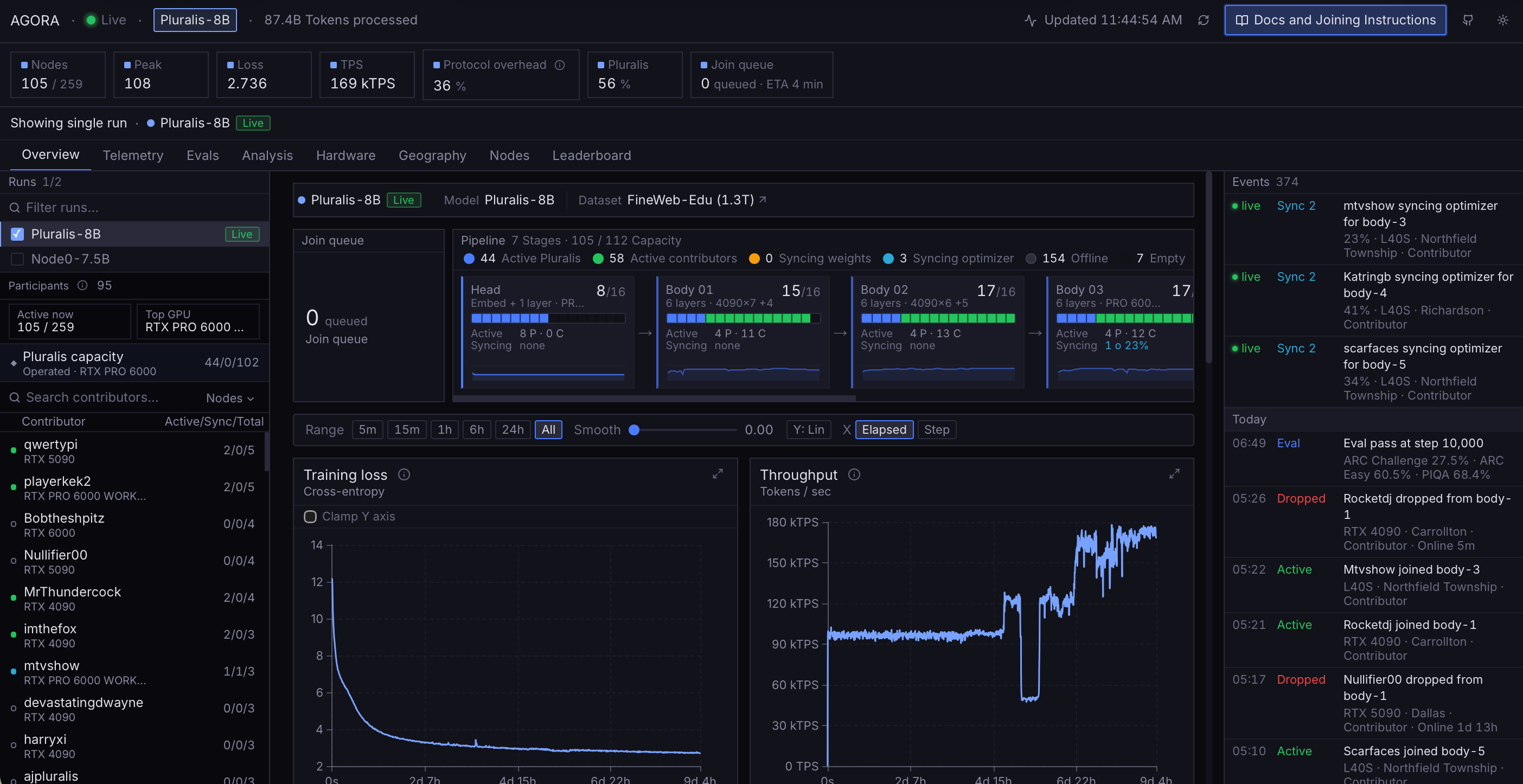
Pluralis, a research lab with one of the most minimalist and sleek-looking sites out there, has released Agora — a technology that allows the use of consumer-grade GPUs for model pretraining.


As a pilot run, Pluralis launched the training of an 8B model using Agora. There are some limitations: the “consumer-grade” GPUs still need to be powerful enough and contain 24GB of VRAM, and the server must be located in North America.
Steffen Cruz, CTO and co-founder of Macrocosmos — a Bittensor-focused company operating its own model-training-oriented subnet, IOTA — praised Agora, writing:
If this shit works, it will completely disrupt the economics of training large models and the floodgates will burst open.
Even if you don’t understand anything about decentralized training, just look at their dashboard!
IV. Bittensor bubbles?
Bittensor enthusiast Tensia Foundation has released its own version of Cryptobubbles, a visual representation of how major cryptocurrencies are doing at the moment. Tensia Bubbles puts all the Bittensor subnets on the same screen in the form of bubbles representing their performance over a certain period of time.
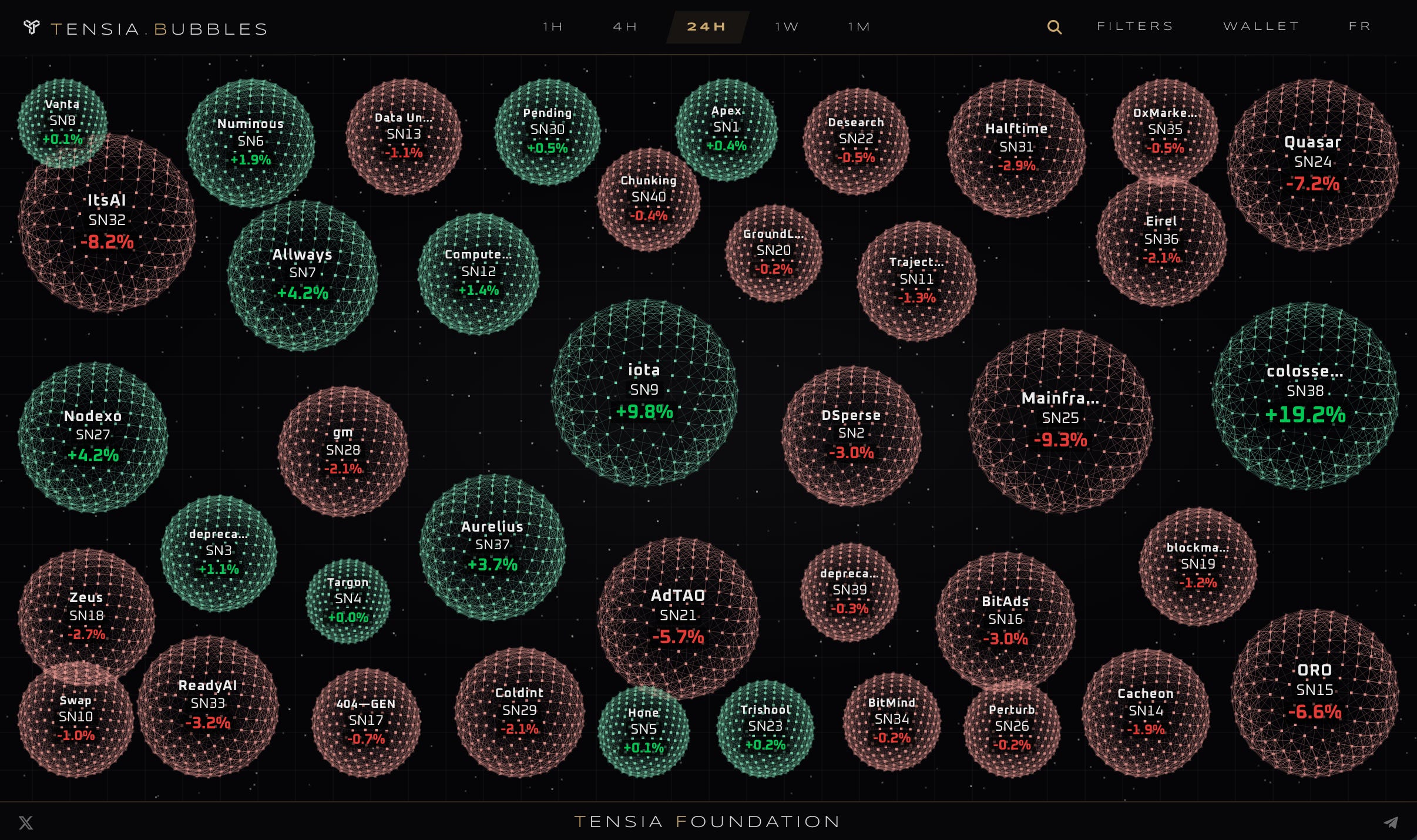
Side note: can we leave the “bubbles” analogy to the centralized labs?
V. Weekend read
The last few decades of technological progress democratized computing; but that era is now over.
David Oks, a research partner on the New Media team at a16z, published a great long read here on Substack, “AI is killing the cheap smartphone.” A sad prediction: consumer electronics will get more and more expensive. Thanks, AI.
That’s it for this week. Please, share your feedback with us by just hitting reply or contacting the author, Sultan Suleimanov, at sult@deaination.com. See you next Saturday!
The Karpathy-to-Anthropic move crystallizes something bigger than one researcher's career choice. As frontier models concentrate, the protocols that let agents talk to each other become the new battleground for openness. A2A and MCP are open transport layers, but the session and trust layers above them are still anyone's game. The question isn't just "who builds the models" — it's "who defines how agents collaborate, trust each other, and involve humans." That layer needs to be open too.
Nebius rising its prices… Whoah. Tougher than a gas station in Alabama.